How to Make Chrome Dark Mode: Quick Answer
- Open Google Chrome.
- Open a new tab.
- Click Customize Chrome in the bottom-right corner.
- Find Appearance.
- Select Dark.
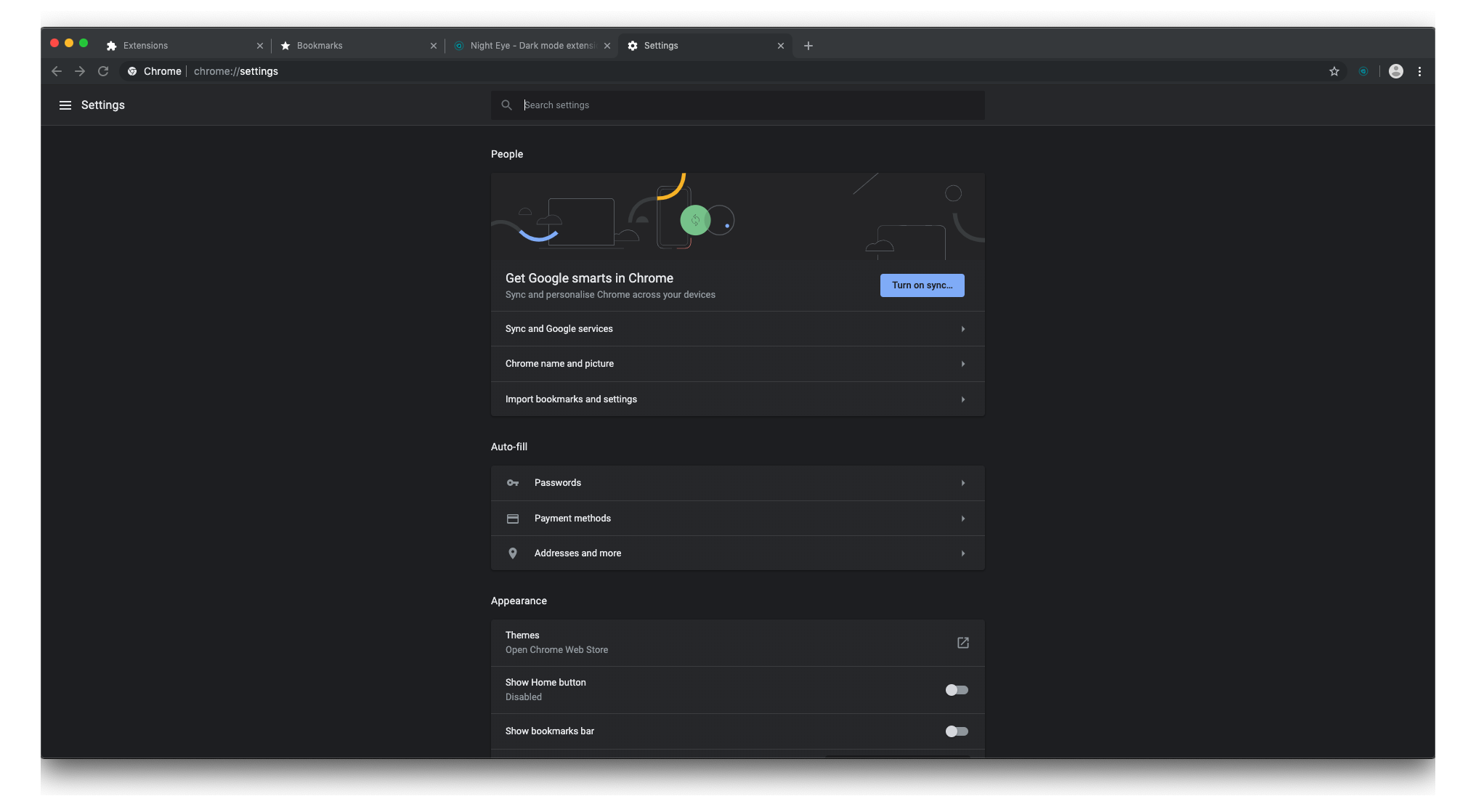
Table of contents
- How to Make Chrome Dark Mode: Quick Answer
- Method 1: Enabling Chrome’s Built-In Dark Mode
- Method 2: Enabling Dark Mode on Mobile Devices
- Method 3: How to Force Dark Mode on All Websites Using Chrome Flags
- The Limitation of Native Chrome Dark Mode
- The Solution: Using a Smart Dark Theme Extension
- Chrome Dark Mode vs Forced Dark Mode vs Night Eye
- Chrome Dark Mode Not Working? Try These Fixes
- Frequently Asked Questions (FAQ)
- Make Chrome Dark Mode Work on Every Website
Method 1: Enabling Chrome’s Built-In Dark Mode
- Open Chrome.
- Open a new tab.
- Click Customize Chrome in the bottom-right corner.
- Open the Appearance section.
- Choose one of these options:
- Light: Chrome always uses a light theme.
- Dark: Chrome always uses a dark theme.
- Device: Chrome follows your computer’s theme.
How to Turn on Chrome Dark Mode on Windows 10 & 11
Option 1: Turn on dark mode inside Chrome
- Open Google Chrome.
- Open a new tab.
- Click Customize Chrome.
- Find Appearance.
- Select Dark.
Option 2: Make Chrome follow Windows dark mode
- Open Settings.
- Select Personalization.
- Select Colors.
- Open Choose your mode.
- Select Dark.
- Open Chrome and choose Device under its Appearance settings.
- Open Start.
- Select Settings.
- Go to Personalization > Colors.
- Find Choose your color.
- Select Dark.
- Set Chrome’s Appearance option to Device.
How to Turn on Chrome Dark Mode on Mac
- Open Chrome.
- Open a new tab.
- Click Customize Chrome.
- Open Appearance.
- Select Dark.
- Open the Apple menu.
- Select System Settings.
- Select Appearance.
- Choose Dark.
- Open Chrome.
- Set Chrome’s Appearance option to Device.
You can choose Auto instead of Dark if you want your Mac to switch between light and dark appearance automatically. Apple currently places these controls under System Settings > Appearance.
Method 2: Enabling Dark Mode on Mobile Devices
Chrome Dark Mode for Android
- Open the Chrome app.
- Tap the three-dot More button.
- Tap Settings.
- Tap Theme.
- Select Dark.
- System Default: Chrome follows your Android device.
- Dark: Chrome always uses its dark theme.
- Light: Chrome always uses its light theme.
Google calls this feature “Dark theme” on Android.
Keep in mind that this setting mainly changes Chrome’s interface. A website may still appear white if it does not have its own dark theme.
Chrome Dark Mode for iPhone & iPad (iOS)
- Open the Settings app.
- Tap Display & Brightness.
- Under Appearance, select Dark.
- Open Chrome.
- Open Settings > Display & Brightness.
- Turn on Automatic.
- Tap Options.
- Choose Sunset to Sunrise or create your own schedule.
Method 3: How to Force Dark Mode on All Websites Using Chrome Flags
- Open Google Chrome.
- Enter the following address in the address bar:
How to Turn Off Forced Dark Mode
- Open: `chrome://flags/#enable-force-dark`
- Change the setting to Default or Disabled.
- Relaunch Chrome.
Important Warning About Chrome Flags
- Images looking strange
- Text becoming difficult to read
- Buttons becoming hard to see
- Incorrect background colors
- Forms or menus losing contrast
- Websites changing after a Chrome update
The Limitation of Native Chrome Dark Mode
- Tabs
- The address bar
- Browser menus
- Settings
- The new tab page
- Some internal Chrome pages
- It does not have a dark theme.
- It's dark theme must be enabled separately.
- It does not follow your device theme.
- It's design uses fixed white backgrounds.
- It's dark mode only works after you sign in.
The Solution: Using a Smart Dark Theme Extension
How to Make Every Website Dark with Night Eye
Three Display Modes
Dark Mode
Filtered Mode
Normal Mode
Chrome Dark Mode vs Forced Dark Mode vs Night Eye
| Method | Chrome interface | Website content | Customization | Best for |
|---|---|---|---|---|
Chrome built-in dark mode
Included with Google Chrome
| Darkens tabs, toolbar, menus and settings | Only websites that provide their own dark theme | Basic choice between Light, Dark and Device | Making the Chrome interface dark without installing an extension |
Chrome force-dark flag
Auto Dark Mode for Web Contents
Experimental
| Does not add extra browser styling | Attempts to recolor most websites automatically | No useful controls for individual websites | Quickly testing forced dark mode when inconsistent results are acceptable |
Dark Mode - Night Eye
Smart dark mode browser extension
Most complete
| Works alongside Chrome's dark theme | Converts supported website content into dark mode | Brightness, contrast, warmth, saturation, dimming and per-site settings | A consistent, customizable dark mode for everyday browsing |
Chrome Dark Mode Not Working? Try These Fixes
Chrome Is Dark, but the Website Is White
- Look for a dark mode setting on the website.
- Test the Chrome force-dark flag.
- Use a dark mode extension such as Dark Mode - Night Eye.
The Customize Chrome Button Is Missing
- Open a new tab.
- Look for the side panel button near the top-right corner.
- Open Customize Chrome.
- Find Appearance.
Chrome Keeps Switching Between Light and Dark
- Open a new tab.
- Select Customize Chrome.
- Open Appearance.
- Select Dark instead of Device.
A Website Looks Wrong in Forced Dark Mode
Frequently Asked Questions (FAQ)
How do I enable dark mode in Google Chrome?
Open a new tab, click Customize Chrome, find Appearance, and select Dark.
How do I make Chrome dark mode on Windows 11?
Go to:
Chrome > New Tab > Customize Chrome > Appearance > Dark
You can also change the Windows theme through:
Settings > Personalization > Colors > Choose your mode > Dark
How do I make Chrome dark mode on Mac?
Open a new Chrome tab and select:
Customize Chrome > Appearance > Dark
To change the appearance of your whole Mac, go to:
Apple menu > System Settings > Appearance > Dark
How do I enable Chrome dark mode on Android?
Open Chrome and go to:
More > Settings > Theme > Dark
How do I enable Chrome dark mode on iPhone?
Go to:
Settings > Display & Brightness > Dark
Chrome will follow your iPhone's appearance setting.
Why does Chrome dark mode not change websites?
Chrome's built-in dark mode mainly changes the browser interface, including its tabs, menus, toolbar and settings. Websites control their own colors, so pages without a dark theme may remain bright.
How do I force all websites into dark mode?
Enter this address in Chrome:
chrome://flags/#enable-force-dark
Find Auto Dark Mode for Web Contents, set it to Enabled, and relaunch Chrome.
This is an experimental feature, so some websites may display incorrect colors, images or text.
What is the best dark mode extension for Chrome?
Night Eye converts bright websites into dark themes and gives you control over brightness, contrast, warmth, saturation and other display settings. It is useful when Chrome's built-in dark mode does not change the websites you visit.
Is Chrome dark mode the same as Incognito mode?
No.
Dark mode changes Chrome's appearance. Incognito mode changes how Chrome stores local browsing activity during a private session.
How do I turn Chrome dark mode off?
On a computer:
New Tab > Customize Chrome > Appearance > Light
On Android:
Chrome > More > Settings > Theme > Light
On iPhone and iPad:
Settings > Display & Brightness > Light
Make Chrome Dark Mode Work on Every Website
Chrome’s built-in dark mode is a good place to start. It quickly changes the browser’s tabs, menus, settings and other interface areas.
However, it does not make every website dark.
Chrome’s experimental force-dark flag can try to convert bright websites, but the results may be inconsistent. Some text, buttons, images or page elements may not display correctly.
For a more reliable and customizable experience, use Dark Mode - Night Eye. It applies dark mode to supported websites and lets you adjust brightness, contrast, warmth and other display settings.
Night Eye also provides support to its users. Some websites may not convert perfectly because they use outdated code or uncommon web standards. When this happens, you can use the built-in support chat and send us the page URL. Our team will review the website and work on improving how it appears in dark mode.
Explore Dark Mode - Night Eye