










Engadget is a favorite among people who can’t get enough tech. If you love reading about the latest gadgets, new devices, and changes in the technology world, Engadget gives you plenty to explore, from hands-on reviews to daily news.
But you might prefer to read all those articles against a darker background. Night Eye can bring dark mode to Engadget in your browser and lets you adjust the result to your liking. You can change the look of the page without giving up the news, photos, and reviews you came to read.
Engadget’s public website did not show us a clearly documented, sitewide dark-mode switch during this review. If you see an Appearance or Theme option in the version you use, try that first. Otherwise, you can use Night Eye to change the webpage itself.
On this page
- How to enable Engadget dark mode
- Preview of Engadget dark mode with Night Eye
- Why readers choose a darker Engadget layout
- Customize Engadget dark mode to your liking
- When to use Engadget dark mode
- Engadget dark mode on phones and tablets
- Engadget dark mode: common questions
- Read Engadget in the colors you prefer
How to enable Engadget dark mode
For regular Engadget visitors, dark mode offers an alternative to the familiar light layout. Night Eye is a browser extension that can turn supported websites, including Engadget, into a darker-looking page.
Follow these steps to set up Engadget dark mode:
- Choose your browser. Visit the Night Eye download page or use the browser installer at the end of this article. Select Chrome, Firefox, Edge, Safari, or another supported browser.
- Install Night Eye. Follow the link to your browser’s official extension store and choose Add, Get, or Install, as appropriate.
- Open Engadget. Go to engadget.com. Night Eye starts in Dark Mode and converts supported pages automatically. If Engadget was already open before installation, refresh that tab.
- Make it yours. Open the Night Eye icon in the browser toolbar to switch between Dark, Filtered, and Normal modes, then adjust the page appearance if needed.
You do not need a separate extension just for Engadget. The same Night Eye installation can be used on other supported websites, with independent settings for sites you want to look different.
Preview of Engadget dark mode with Night Eye
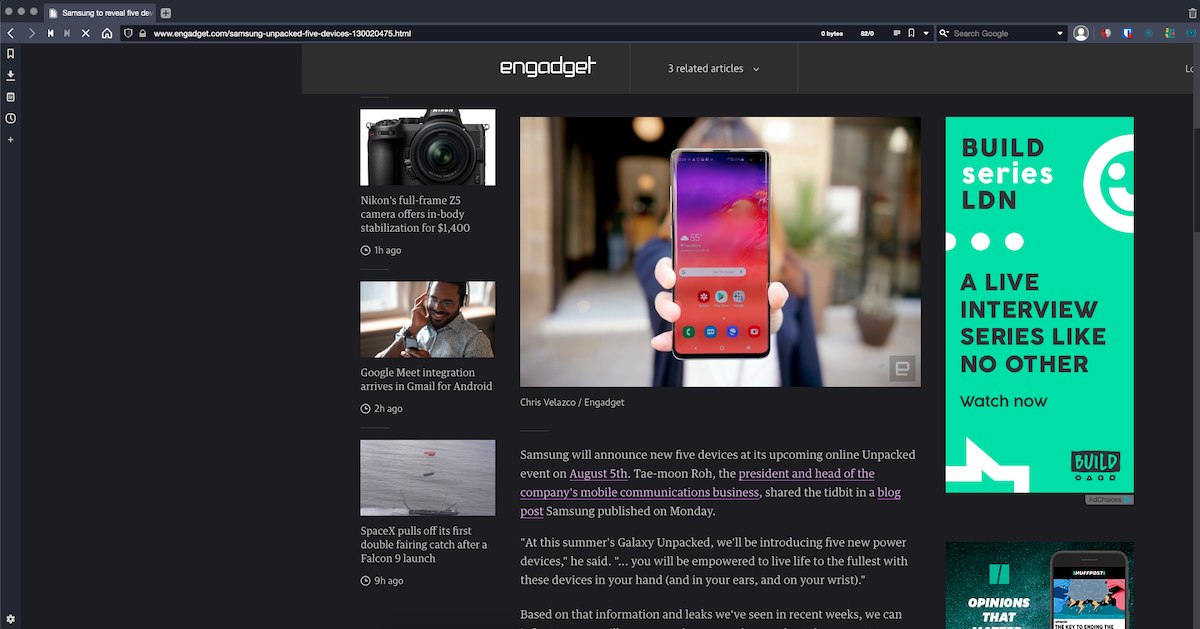
Here are examples of Engadget’s original light appearance compared with Night Eye’s dark-mode conversion. Move the comparison slider to view the change.
These are archived screenshots from 2019, so Engadget’s current layout, images, and navigation may look different. They illustrate the dark-mode effect, not a current screenshot of the site.


The following examples were captured for an earlier Night Eye article in 2020. They are retained as additional visual references; the live website has changed since then.

Why readers choose a darker Engadget layout
Let’s face it: not everyone likes reading long articles on a large white background. The contrast between a bright page and a dark room can be distracting, especially when you move between several websites with different color schemes.
A dark Engadget theme changes the visual presentation while leaving the underlying stories and reviews available to read. Some people prefer darker backgrounds for lengthy articles; others like Engadget as it is. The useful part is being able to choose.
How did Engadget begin?
Engadget has been reporting on gadgets and technology since 2004, when it was founded by Peter Rojas. The site has changed owners several times, most recently joining Static Media in 2026. Its mix of technology news, reviews, and buying guides is still what brings readers back. You can read more on Engadget’s About page.
Customize Engadget dark mode to your liking
Night Eye is more than a simple light-to-dark switch. After enabling it on Engadget, you can adjust brightness, contrast, saturation, dimming, and color warmth to get a look that fits your preferences.
If you like the site's original colors but want a less bright presentation, try Filtered Mode. Choose Dark Mode for the full conversion, or Normal Mode to leave Engadget unchanged. Night Eye can remember website-specific preferences, so changing Engadget does not have to affect every other site you visit.
What if a website already has built-in dark mode? You can still use Night Eye to personalize its appearance, including brightness and contrast adjustments where compatible. A native theme and Night Eye serve different purposes: one selects the site's own design, while the other provides additional appearance controls or its own conversion.
You can also schedule dark mode, follow your supported operating-system color scheme, and configure individual websites or subdomains. Night Eye processes page color changes locally and does not collect your browsing history as part of that conversion. See the Night Eye features and Help Center for additional settings.
When to use Engadget dark mode
There is no single setting that suits everyone. You may want Engadget to stay dark all day, or you may prefer to switch its appearance depending on what you are reading and where you are browsing.
- In a dim room: choose a darker background and fine-tune the page brightness to match your surroundings.
- For a long review: use the contrast controls to find a text-and-background combination you like.
- For photo-heavy articles: compare Dark and Filtered modes to see which preserves the presentation you prefer.
- For a consistent browsing setup: use a schedule or supported system-theme integration so Engadget follows your usual light/dark routine.
Dark mode is an appearance preference, not a medical treatment. You can switch back to Engadget’s original presentation at any time using Normal Mode.
Engadget dark mode on phones and tablets
Night Eye also supports Safari on iPhone and iPad. After installing the Safari extension, enable it in Safari’s extension settings and allow the required website access so it can change Engadget’s appearance.
On Android, extension support depends on the browser. Night Eye is available through compatible browsers such as Firefox for Android, Edge for Android, and Yandex Browser for Android. A browser’s own dark interface does not necessarily turn the Engadget webpage dark.
For device-specific installation steps, check the Night Eye setup guide.
Engadget dark mode: common questions
Does Engadget have a built-in dark mode?
We could not verify a dedicated, sitewide dark-mode control on the public Engadget website at the time of this update. Check any current Theme or Appearance menu first. If the webpage remains light, Night Eye can apply a dark appearance from your browser.
Can I customize Engadget if it already appears dark?
Yes. Night Eye can provide additional appearance controls for websites with their own dark themes, where compatible. You can adjust brightness and contrast, or use Night Eye’s own Dark Mode conversion instead of relying only on the website theme.
Why did Engadget stay light after I installed Night Eye?
Refresh the Engadget tab, check that the extension has permission to run on the website, and confirm that Night Eye is set to Dark rather than Normal. If the result still looks wrong, use Night Eye’s built-in support option.
Can I keep other websites in light mode?
Yes. Use per-website modes and your allow/disallow settings. You can keep Engadget in Dark Mode and leave another site in Normal Mode, or do the opposite.
Read Engadget in the colors you prefer
Engadget has plenty of articles for gadget lovers to explore. If its usual page colors are not your favorite, Night Eye offers a straightforward way to change them, save your preferences, and continue reading in the style you prefer.
Install Night Eye without a credit card to try its Pro features for three months. Afterward, you can continue with Night Eye Lite free on up to five websites in one browser, or choose a paid plan for unlimited websites. For current options, see Night Eye plans and pricing.